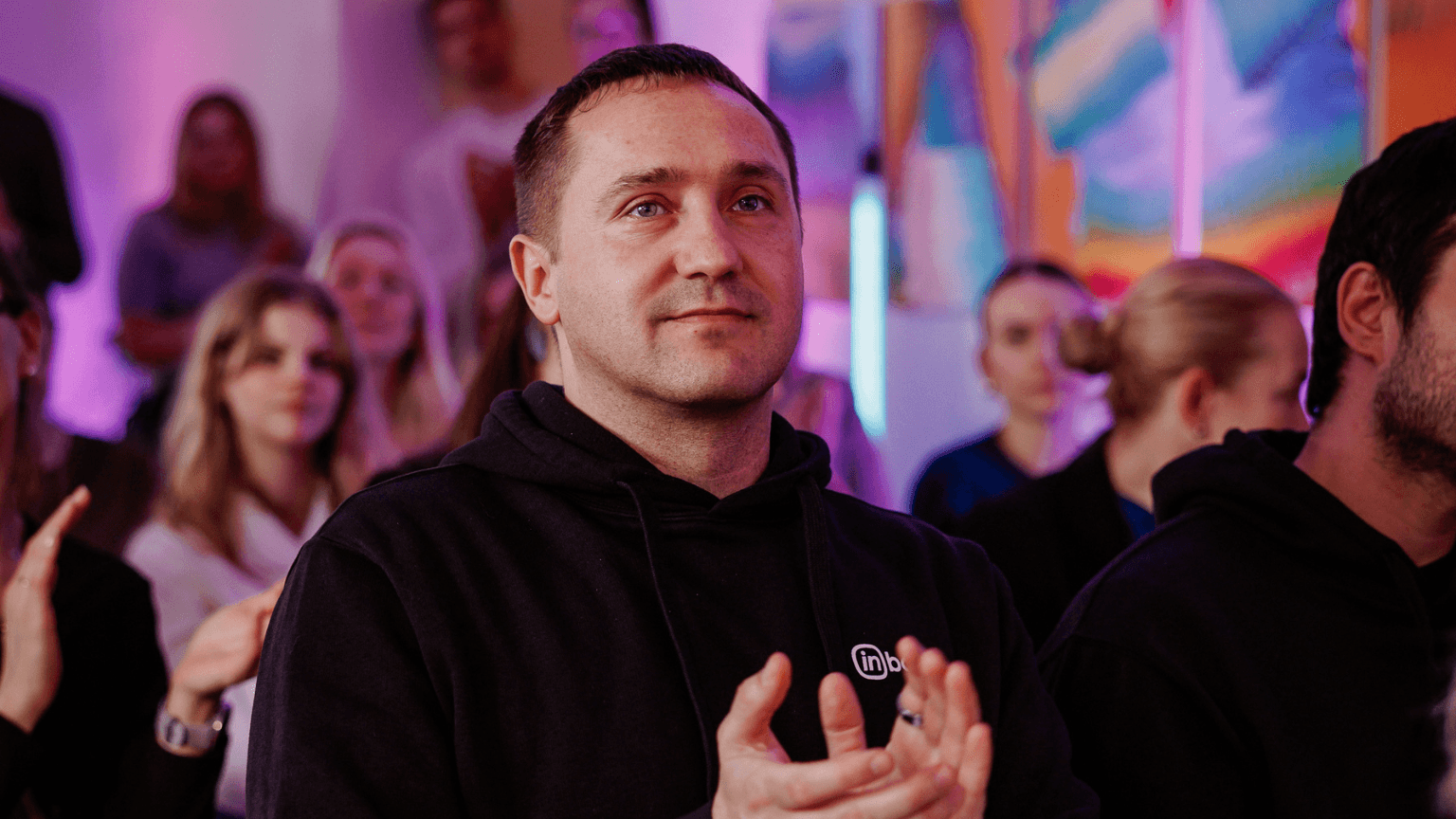
Egon's professional journey has been both diverse and impressive. He holds a master's degree in Management and Marketing from Tallinn University of Technology and also studied abroad in France as an exchange student. He co-founded the European Innovation Academy and even tried building a startup of his own. Later, he joined Taxify, now known as Bolt, in Mexico, where he gained first-hand experience in scaling a fast-growing technology company in an international market. While in Mexico, Egon also worked at a fintech company focused on improving access to credit across Latin America.
"In 2022, I returned to Estonia and joined //kood because I wanted to complement my previous experience with strong technical skills. I was motivated by the desire to move closer to creating technology rather than being only on the business and growth side," he recalls.
Looking back, Egon describes his experience at //kood as highly practical, intensive, and transformative.
"What attracted me from the beginning was that learning did not happen through traditional lectures but through building things, experimenting, and solving problems together with others. What surprised me the most was how much you can learn through self-directed and peer-to-peer learning. The //kood community was also extremely valuable to me. I was surrounded by people who were equally motivated and facing similar challenges."
How a Diverse Background Became a Bridge to Higher Education
//kood collaborates with universities, allowing graduates to continue their studies after completing the program. Each cohort's top ten graduates are offered admission under special conditions to bachelor's degree programmes at TalTech's School of Information Technologies.
Egon was among them and is currently studying Information Systems Development at the bachelor's level.
"//kood provided a strong project-based practical foundation, but pursuing a university degree felt like an opportunity to go deeper, gain a more systematic understanding, and broaden my perspective of the entire IT field," he explains, describing higher education as the natural next step in his journey.
Attitude and Motivation Cannot Be Taught, Everything Else Can Be Learned
Today, alongside his studies, Egon has been working at Inbank as a Product Engineer for nearly two years.
According to Tiiu Ehastu, Operations Manager in Inbank's Product and Technology Unit, Egon's previous experience at //kood had already built a strong foundation and demonstrated during the recruitment process that he possessed solid logical thinking skills and an understanding of various aspects of technology.
"More importantly, we saw his desire to contribute and build something meaningful together. That attitude and motivation cannot be taught. Everything else can be developed and learned on the job."
Egon says the biggest reality check between studying and working was discovering that real-life projects are rarely as clearly defined as learning assignments.
"At work, you are no longer solving isolated tasks. You are working within existing systems, business priorities, and team agreements. Some systems are extremely large, and every change requires careful consideration to ensure the business continues operating smoothly and that nothing breaks for end users. During studies, the focus is primarily on making the solution work and learning from the process."
"In a professional environment, scalability, long-term system sustainability, collaboration with other developers, and the impact of your work on customers and business goals all become equally important."
According to Egon, his current development focus is transitioning from being a good developer to becoming a more holistic engineer.
"That means not only writing code but also improving systems thinking, understanding architecture, justifying technical decisions, and seeing the broader impact of your work. The more experience you gain, the more you realise that growth is not only about learning new technologies but also about making better decisions."
Technical Roles Require More Than Coding Skills
Today, companies place significant value on soft skills. Clear communication, structured thinking, asking good questions, collaborating with both technical and business teams, and understanding how technical decisions affect user experience, product development, and business outcomes are increasingly important.
"Regardless of the role, the ability to think outside the box, stay curious, and remain open to new technologies is essential. Technology roles are evolving rapidly, and the development of artificial intelligence has significantly changed previous assumptions. Writing code alone is no longer the primary measure of quality. Increasingly, success depends on solving problems intelligently, using different tools, including AI, and navigating a constantly changing environment. We are looking for people who have both the energy and the ability to learn and adapt quickly," says Tiiu.
In her view, flexibility and adaptability are among the most important indicators of a person's potential to grow quickly in a technology role.
"Critical thinking and the ability to evaluate information rather than simply accept it are equally important. Internal motivation, the desire to build something meaningful and contribute to the end result, also plays a major role. Artificial intelligence has fundamentally changed the rules of the game. Today, almost anyone can generate code. As a result, how people think, solve problems, and use different tools to achieve their goals has become far more important."
Artificial Intelligence Makes It Easier to Fail Faster and Succeed Faster
At Inbank, teams operate as product teams where product and development work closely together. Developers are not simply implementers but active contributors to shaping the product itself.
"They participate in discussions, help prioritise, and jointly decide what truly matters for customers. Often, the biggest challenge is translating ideas into functional solutions and identifying the most valuable thing to build, while understanding how development decisions influence both user experience and business results," says Tiiu.
From a technical perspective, the focus is on rapid iteration and continuous experimentation.
"Artificial intelligence allows us to both fail faster and succeed faster. This means that people in technical roles must learn, adapt, and improve their decision-making much more quickly with every new iteration."
Egon describes his typical workday:
"My day usually starts with reviewing priorities and ongoing tasks. Then we have a team meeting or sync to discuss progress and identify any blockers. The rest of the day is typically spent developing, reading code, thinking through solutions, testing, and occasionally discussing ideas with colleagues. What I enjoy most is the balance between deep focus and collaboration. On one hand, you need to solve problems independently. On the other hand, the best solutions often emerge through teamwork."
Advice for Anyone Interested in Starting a Career in Technology
Tiiu's advice: "Build things yourself. Create small projects, whether it's a game, a simple application, or any idea that genuinely interests you, and let your friends, family, or even the wider internet use and test them. The best way to learn product development is to be involved in the entire process from idea to implementation. This helps you learn not only how to build but also how to listen to users and understand what truly creates value."
Egon's advice: "Don't wait until you feel completely ready. Often, you need to take the next step before you have the full picture. If you're interested in technology and willing to put in consistent effort, you can learn a tremendous amount even when starting from a completely new position. Every new challenge is difficult and uncomfortable at first. The most important thing is to begin, stay consistent, and be willing to tolerate discomfort, because that's where the fastest growth happens."
The final Selection Sprint of 2026 will take place from July 20 to August 7 in Jõhvi, Paide, and Võru. Applications are open from June 1 to July 5.
In September, //kood will launch an updated curriculum that combines technical skills more closely with real-world product development, AI utilisation, and professional engineering practices. The project-based learning model focuses on building systems and products, making well-reasoned technical decisions, and working in an environment that closely resembles the day-to-day reality of a professional product team.